.png?width=172&height=34&name=JSC%20(1200%20x%20240%20px).png)
.png?width=466&name=JSC%20Top%20Personas%20-%20Linkedin%20Ads%20(1).png "JSC Top Personas - Linkedin Ads (1)")

On February 18, 2025, HubSpot announced it was retiring its legacy scoring properties — the single "HubSpot Score" most portals had used for years — and replacing them with a purpose-built Lead Scoring tool. The retirement ran on a clock, and the important date has already passed: since August 31, 2025, legacy scores stopped updating entirely.
If your portal still runs on the old property, this is the short version: that number is frozen at whatever it was last August, any workflow or list reading from it is making decisions on stale data, and HubSpot is now periodically deleting unused legacy scores. This post covers what replaced it, the full timeline, and how to migrate — cleanly, in an afternoon.
The timeline, and where you are on it
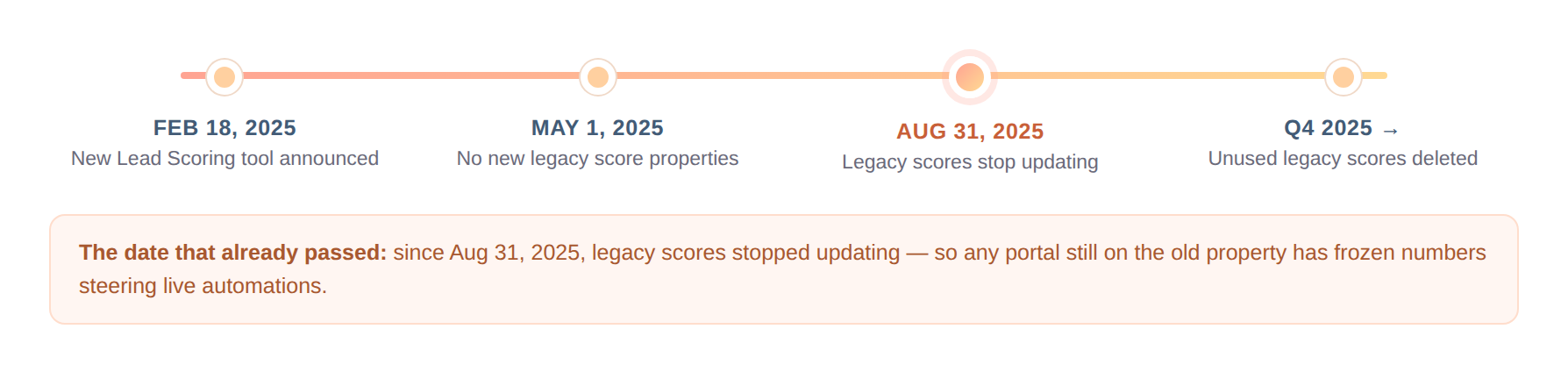
HubSpot gave eight months' notice and phased the change:
- February 18, 2025 — the new Lead Scoring tool is announced.
- May 1, 2025 — you can no longer create new legacy custom score properties.
- August 31, 2025 — existing legacy scores stop updating. Anything scored after this date is running on a dead engine.
- Q4 2025 onward — legacy scores not used in an active asset get periodically deleted.
The practical read: if you built on the old score before mid-2025 and haven't touched it since, you have frozen numbers quietly steering live automations. That's the problem this migration fixes.
What replaced it
New Score Types
The new Lead Scoring tool (Marketing Hub Professional and Enterprise) splits scoring into separate, purpose-built models instead of one catch-all number:
👤 Contact Fit Score — how well someone matches your ideal customer, from firmographic and technographic traits (company size, industry, title, tech stack).🛍️ Contact Engagement Score — how actively they're behaving like a buyer (pricing-page visits, demo requests, content, and product signals).
🎯 Combined Score — a weighted blend of the two, which is what most teams route on.
You don't have to segment on the raw number, though — and mostly you won't. For each score, HubSpot builds a score threshold property that buckets contacts into labeled, color-coded tiers, and that's usually what you'll actually build lists and workflows on.
Fit and engagement each get a simple High / Medium / Low, and you set the cutoffs (say, 70–100 as High, 40–69 as Medium, everything below as Low).
The combined score gets a nine-box grade — A1 through C3 — where the letter is the fit tier and the number is the engagement tier, so an "A1" is your best-fit, most-engaged contact and a "C3" is neither.
The tier labels are fixed; the ranges behind them are yours to tune. The practical payoff: you route on "A1 and A2" instead of memorizing point values, and HubSpot's grade is the fit-versus-engagement matrix, baked into a single property.
.png?width=1700&height=1080&name=Lead%20Scoring%20(1).png)
New Features
A few of the mechanics are worth understanding, because they're where the new tool earns its keep:
📉 Score decay lets you reduce a score over time based on how recently and how often someone engages. It matters because engagement without decay is just a lifetime accumulator — a contact who binged your site in the spring and then vanished still reads as red-hot in the fall, and a rep wastes a call on someone who's moved on. With decay, the number reflects who's interested now, so the leads reaching sales are actually warm.
.webp?width=1920&height=707&name=filters_quality(75).webp)
📊 The distribution preview shows how your whole database spreads across the score range before you switch anything on. It matters because it's your one chance to catch a too-generous model in the design phase instead of on launch day. If 80% of your contacts land above your intended MQL line, you'll see it in the preview and fix the cutoffs — rather than dumping four thousand "qualified" leads on a sales team that immediately stops trusting the score.
🏥 Health scores (on Service Hub) bring the same scoring idea to customers you've already won, inside the customer success workspace. It matters because the signals that predict churn or an expansion opportunity aren't the ones that predict a first purchase — health scoring lets CS watch account health and step in on a slipping customer well before the renewal conversation, instead of during it.
For a full walkthrough of building the new model from scratch — fit criteria, engagement criteria, thresholds, and the workflows that use the score — see our guide to setting up lead scoring in HubSpot for B2B SaaS. This post is about getting off the old one.

How to migrate off the legacy score
Migration is mostly detective work: the old score didn't disappear, it froze, so nothing throws an error. You have to find every place it's still wired in and repoint it. The good news is that HubSpot tracks most of that for you. Work in this order.
1. Let HubSpot show you where the score is used.
The legacy score is a property, and every HubSpot property keeps a record of what depends on it. Go to Settings → Properties, set the object to Contact, and open your legacy score property (the old "HubSpot Score," or any custom score properties you built). Open its "Used in" tab: HubSpot lists the assets that reference it — active lists, workflows, forms, and more — with links straight to each one. That list is your migration inventory. Export it or drop it into a checklist and you've done most of the audit in a single click.
Then cover the few references "Used in" doesn't reliably surface, because a single missed one keeps running on a frozen number:
- Reports and dashboards filtered or grouped by the score — scan your key ones by hand.
- Custom-code or webhook workflow actions that reference the score inside the action itself, rather than in enrollment or branch criteria.
- Integrations and data syncs — a Salesforce sync, a warehouse or reverse-ETL pipe, Zapier, or an ABM tool reads the score over the API and won't appear in "Used in" at all. Check your Connected Apps separately.
2. Rebuild the model in the new tool.
Recreate your scoring logic as a Combined Score (fit + engagement) in Marketing → Lead Scoring. This is the moment to improve it rather than copy it one-for-one — the old single score almost certainly bundled fit and behavior together, and splitting them is the upgrade. The setup guide has the full rubric.
3. Repoint each reference to the new score.
Work down your inventory from step 1 and swap the legacy property for the new combined score in every workflow, list, report, and lifecycle rule. Do it one asset at a time so you can confirm each still behaves — and watch the property's "Used in" count as you go; it should tick toward zero.
4. Verify, then retire the old property.
Watch the new score populate for a week, spot-check that automations fire the way they used to, then confirm "Used in" shows nothing left. Once nothing depends on it, HubSpot's cleanup deleting the old property is a non-event instead of a fire.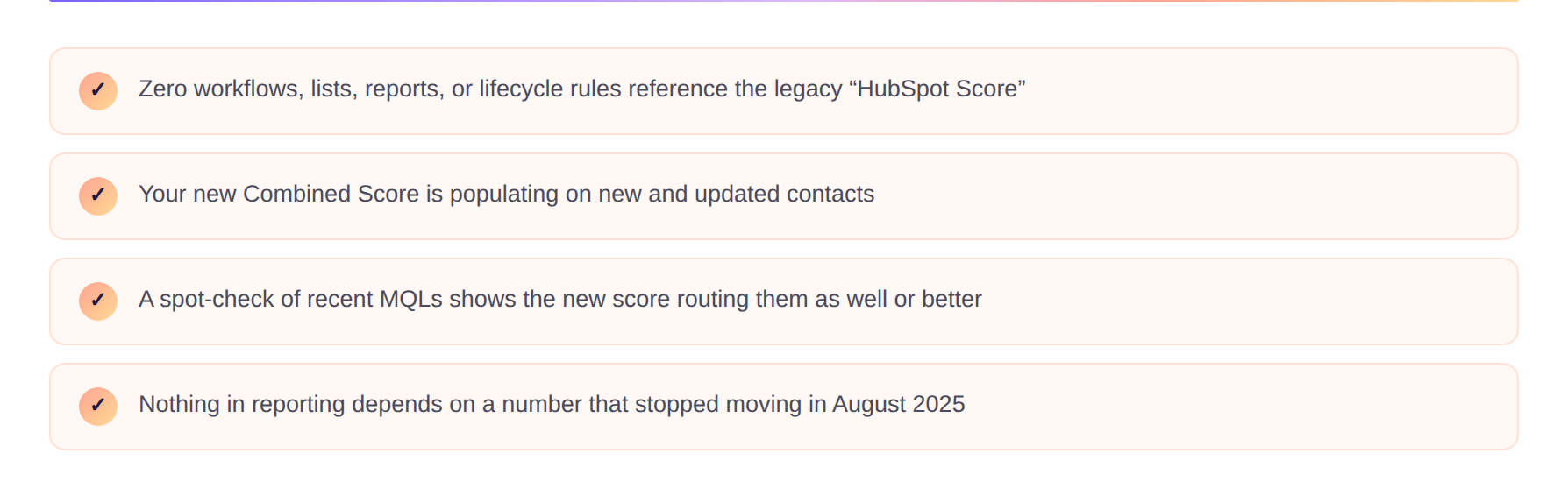
You're done when you can check all of these:
- Zero workflows, lists, reports, or lifecycle rules still reference the legacy "HubSpot Score" property.
- Your new Combined Score is populating on new and updated contacts.
- A spot-check of recent MQLs shows the new score routing them the way the old one did — or better.
- Nothing in your reporting depends on a number that stopped moving in August 2025.
If your scoring has been quietly frozen since last summer, the fix is an afternoon of inventory and repointing, not a rebuild from zero. Do the inventory first — that's the part everyone underestimates and the part that breaks things when it's skipped.
Full disclosure: If you want HubSpot changes broken down like this — what moved, what to do, and by when — subscribe to Funnel Vision.