.png?width=172&height=34&name=JSC%20(1200%20x%20240%20px).png)
.png?width=200&name=JSC%20Services%20%20Blog%20Images%20(30).png "JSC Services Blog Images (30)")

An indecisive customer in B2B sales is a buyer who has clear interest in your product but keeps delaying the purchase decision — not because they're shopping competitors, but because the decision feels too risky, too political, or too unclear internally. They show all the buying signals (multiple meetings, technical questions, executive sponsor named) but the deal still doesn't close. If you're a salesperson or revenue leader trying to move stuck deals forward, this post is for you. If you're looking for a dictionary definition of "indecisive," there are better pages for that — close this tab now.
(Originally published 2024. Updated May 2026 to sharpen the B2B sales focus.)
Let's start with a definition.
What is an Indecisive Customer?
An indecisive customer is a buyer who shows genuine interest in your product or service but delays, stalls, or avoids committing to a purchase decision. In B2B sales, this is a massive problem — research suggests that 40–60% of qualified pipeline deals end not in a competitor win, but in no decision at all. This article breaks down why buyer indecision happens, why traditional sales pressure makes it worse, and what actually works to move hesitant buyers forward.
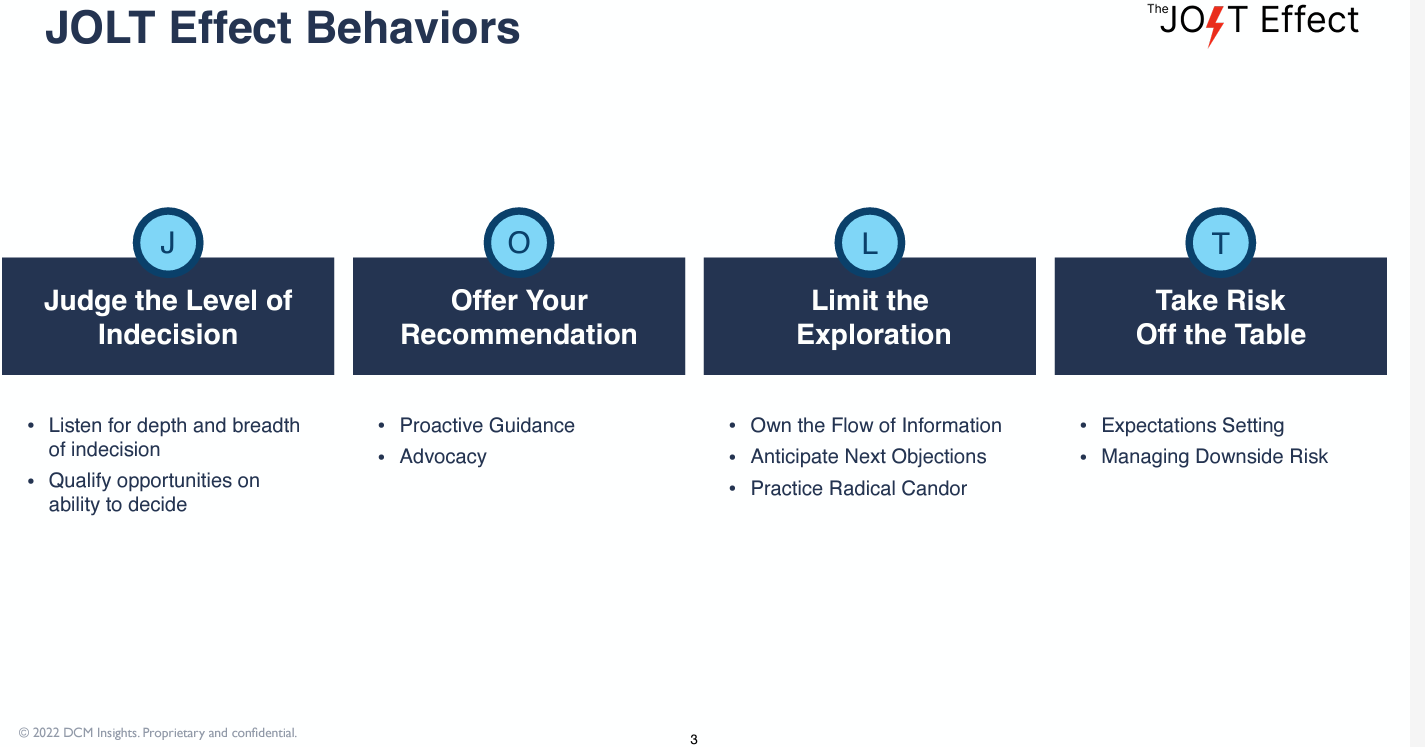
According to research by Matthew Dixon and Ted McKenna in their book "The Jolt Effect", a staggering 40-60% of B2B technology sales processes end in indecision—not with a competitor winning, but with no decision being made at all.
This makes indecision your largest, most dangerous competitor—bigger than any direct rival in your space.
The Psychology Behind Buyer Indecision
Once purchase intent is established, customers shift their focus from "Will this help me succeed?" to "What if this causes me to fail?"
This psychological shift means that despite genuine interest in your product, external risk factors overshadow the decision to proceed.
Key factors that drive indecision include:
- Limited or uncertain budget availability.
- Organizational dysfunction or toxic culture.
- Unstable or unclear leadership.
- Constantly shifting departmental priorities.
- Fear of personal career consequences from a "wrong" choice.
Why Traditional Sales Tactics Fail With Indecisive Customers
When I was producing a competitive analysis for a client recently, I realized I had left our largest, most dangerous competitor out of my analysis entirely: indecision.
In the companies I've worked for, I've gotten to work alongside some truly remarkable sales professionals. These folks talked constantly about our competitors—how we differentiate from them, how we can do what they cannot, and so on. I also heard them speak frequently about losing deals to the status quo, where buyers stick with spreadsheets or imperfect existing solutions.
But I witnessed far fewer conversations about indecision and how to address it. There's a logical reason: an indecisive customer feels like a relationship you just need to keep working on. The deal isn't dead—it's just asleep.
The Backfire Effect
Traditional sales practices tell you to push harder: deliver more features, more comparisons, more proof points. But this approach backfires with indecisive customers.
Why? Because your customers have already been convinced you're the best solution for them. They're not asking for more information to make a decision—they're asking for it hoping something will magically eliminate their fear of negative outcomes.
©2022 Matthew Dixon, Ted McKenna (P)2022 Penguin
How To Deal With Indecisive Customers: Proven Strategies
If we want to truly address indecisive customers, we need to do three things much better:
-
Have a plan to address indecision proactively
-
Identify the signs of a deal slipping away before it does
-
Focus on the right customers and let go of the wrong ones
Easier said than done, right? Here are some proven strategies to get you started.
Trim Your Audience Ruthlessly
Indecisive customers can consume enormous amounts of your time. Before investing heavily, ensure you're dealing with someone who:
- Is an actual decision-maker or strong influencer
- Has the authority to make (or heavily influence) final decisions.
- Represents a business opportunity worth your time investment
Action Step:
Qualify hard early. Ask direct questions about budget authority, decision-making process, and timeline consequences. If you get vague answers, consider whether this prospect deserves continued investment.
Address The Risk of Inaction (Not Just The Benefits of Action)
While highlighting your solution's benefits is essential, you must pivot to emphasizing the risks of doing nothing when prospects become indecisive.
Most people fear making a choice that leads to negative outcomes MORE than they fear allowing bad things to happen through inaction. This seems counterintuitive, but it's human psychology.
What To Stress:
- Security vulnerabilities that remain unaddressed
- Revenue opportunities being lost daily
- Competitive advantages your competitors are gaining right now
- The compounding cost of delay
Key Phrase To Use: "What's the cost of waiting another quarter to address this?"
Position Your Product as Essential, Not Optional
To overcome indecision, your product must be seen as indispensable. Help your champion within the prospective company understand how to present your service as a must-have rather than a nice-to-have.
This involves showcasing the critical role your product plays in mitigating risks—not just achieving goals. Remember: you've already convinced them of your utility. Now you must show them how your product protects them against external forces outside anyone's control.
Reframe the conversation from:
❌ "This will help you grow 20% faster"
✅ "Without this, you're exposed to [specific risk] that could cost you [specific outcome]"
A Marketing Automation Strategy For The Indecisive Customer
All of the above tactics can be tested, scaled and added to strategic planning. Here Here's how to build a repeatable process for handling indecision:
Add Lead Scoring or Lifecycle Stages that Include Indecision
Start by identifying metrics that indicate indecision in your CRM.
Quantitative signals (system-detected):
- Deal open for 150%+ of your average sales cycle
- High email engagement but no meeting progression
- Multiple content downloads but stalled decision timeline
- Champion opens every email but stops responding
Qualitative signals (sales rep-assigned):
- Buyer asks for "more time to think"
- Requests for additional stakeholder meetings that never materialize
- Increased requests for information without clear next steps
- Budget conversations that keep getting deferred
Create a distinct lifecycle stage or lead score adjustment for "Indecisive - Risk Assessment Needed" that triggers specific workflows.
Create A Content Brief for Custom Sales Enablement Reports
Closing indecisive customers requires custom work from sales reps to outline the **risks of inaction** specific to each client. To drive this point home, arm your sales team with:
Report templates:
- Industry-specific risk analysis frameworks
- Branded charts and graphs showing cost-of-delay calculations
- Case studies of similar companies that waited (and what it cost them)
- Timeline visualization tools showing compounding consequences
Example template titles:
- "The 90-Day Cost of Delayed [Solution] Implementation for [Industry]"
- "Risk Assessment: What [Competitor] Gained While You Evaluated"
- "Your Current Vulnerability: A Security/Revenue/Efficiency Audit"
This is where your marketing team becomes essential—they need to be prepared to fulfill these custom requests quickly, using pre-built frameworks that can be personalized. (If your team doesn't have senior marketing leadership in place to design this kind of process, that's exactly the kind of strategic gap a part-time CMO is built to fill.)
Leveraging Social Proof Strategically
Whether it's filming testimonials, collecting quotes, or arranging networking meetings, connecting indecisive prospects with happy customers who have faced similar challenges is powerful.
The key is customization—understand your indecisive prospect's specific fears and make sure your customer references have prepared stories that directly address those concerns.
Do NOT use generic testimonials like:** "Great product, highly recommend!"
DO use specific narratives like:** "I was terrified our CFO would kill this project if it didn't show ROI in Q1. Here's how we proved value in 6 weeks..."
Building Your Indecision Content Library
Once you've identified indecisive customers as a segment worth targeting, create a messaging strategy and content library around overcoming indecision:
Questions to answer with content:
- How can your product become essential (not optional)?
- What specific risks do you mitigate?
- What external forces do you protect against?
- How have you overcome these objections before?
- What proof do you have that waiting costs money/security/opportunity?
Content Formats That Work:
- ROI calculators showing cost of delay
- Risk assessment frameworks
- Before/after case studies emphasizing what changed
- Industry benchmark reports
- Recorded customer interviews addressing common fears
The Bottom Line: Beat Indecision By Being Decisive
As long as you are decisive in your planning, strategy, and execution, you can overcome customer indecision and get to action more quickly and efficiently than ever before.
Remember: Indecision isn't a sales problem—it's a marketing strategy opportunity. By systematizing how you identify, address, and close indecisive customers, you transform your largest competitor into a competitive advantage.
Frequently Asked Questions
What does 'indecisive customer' mean?
An indecisive customer is a qualified buyer who shows genuine interest in your product or service but cannot commit to a purchase decision. Unlike prospects who choose a competitor or decide to stick with the status quo, indecisive customers remain stuck — often paralyzed by the fear of making the wrong choice rather than by any real objection to your solution.
How do you handle an indecisive customer?
The most effective approach is to stop selling harder and start reducing risk. Qualify early to make sure you're working with a real decision-maker, then shift your messaging from the benefits of buying to the cost of doing nothing. Position your product as essential rather than optional, use social proof from customers who faced similar fears, and build a repeatable process inside your CRM to identify and address indecision signals before deals stall out.
What causes buyer indecision in B2B?
Buyer indecision is usually driven by fear of negative outcomes, not by a lack of information. Once a prospect believes your solution can help them succeed, their thinking shifts to "what if this causes me to fail?" Common triggers include uncertain budgets, unclear leadership, shifting priorities, and personal career risk. According to research in "The Jolt Effect" by Dixon and McKenna, 40–60% of B2B sales processes end in no decision at all — making indecision a bigger threat than any direct competitor.
Is an indecisive customer the same as an uninterested one?
No — and confusing the two is a common mistake. An uninterested customer hasn't been convinced your solution is right for them. An indecisive customer already believes in the value you offer but can't pull the trigger on a decision. The strategies for each are completely different: uninterested buyers need more persuasion, while indecisive buyers need less risk and more confidence that choosing you won't backfire.
How can marketing help close indecisive customers?
Marketing plays a critical role by building a content library focused on risk mitigation rather than feature promotion. This includes ROI calculators showing the cost of delay, industry-specific risk assessments, case studies that emphasize what changed after implementation, and custom sales enablement reports your reps can personalize for each deal. The goal is to give your sales team ready-made tools that address the fear of failure head-on.
Additional Resources & Citations
Book: "The Jolt Effect: How High Performers Overcome Customer Indecision" by Matthew Dixon and Ted McKenna (https://www.amazon.com/s?k=the+jolt+effect) - The foundational research behind this post's statistics and strategies
Image Source: Strategic Discipline Positioning Systems - The Jolt Effect Behaviors (https://strategicdiscipline.positioningsystems.com/hs-fs/hubfs/The%20Jolt%20Effect%20-%20Behaviors.png).