.png?width=172&height=34&name=JSC%20(1200%20x%20240%20px).png)


On July 30, LinkedIn added a button to every post: Seems like AI slop. Members clicked it more than a million times in the first two weeks, and LinkedIn's chief product officer says posts it classifies as slop now get 40% fewer views.
The trouble is, people are bad at this. In a 2024 study of 1,634 readers, AI-written poems were judged human more often than poems by actual poets, T.S. Eliot included. Across 3,002 people in the U.S., Germany and China, AI-generated images, audio and text were rated more human-like than the real thing.
So the button catches slop. It also catches the headshot your designer smoothed a little too much, and the anniversary caption you wrote yourself.
You could ask an AI whether your post looks like AI. LinkedIn more or less does -- it feeds those flags into its own classifiers. I wanted the answer to come from people. Make It Human grades your content against what a dozen published studies, covering more than 70,000 participants, found people actually use to decide something is AI: waxy skin, mangled hands, stock phrases, polish with nothing specific behind it. And what they read as real: names, rooms, numbers, the mess at the edge of the frame.
So I built a grader.

Check out Make It Human, a free AI skill. Drop in a photo, a video or a post. Get a letter grade for how human it reads, and the things only you can add to fix it.

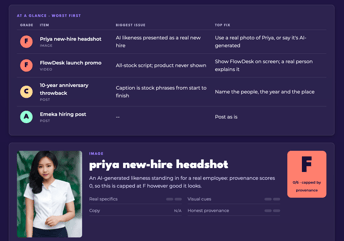
✅ Grades images, video and captions on specifics, visual tells, and accuracy.
✅ Identifies offending material, then asks for human context.
✅ Run ten posts at once and get one scorecard, worst grade first.

Getting read as AI costs you twice: once with the platforms, and again with the people you're trying to reach.
The platforms bury it. LinkedIn shows flagged posts to fewer people outside your network. YouTube demonetizes channels built on generic, template-style content. TikTok and Pinterest let users turn AI content down in their feeds, and Substack now lets readers scan a post for AI.
Audiences aren't any kinder. Pew found 52% of U.S. adults are more concerned than excited about AI, up from 37% in 2021. In a study of 4,976 people, headlines labeled AI-generated were rated less accurate and shared less -- including headlines a human wrote.
Across the research, the same signals came up again and again. The one that held across text and images alike was specific detail only a person can add -- who's in the photo, where it was taken, what actually happened. Then the visual tells people check for (waxy skin, mangled hands, generic blurred backgrounds), and the stock phrases that read as machine-written. We added a fourth ourselves: whether the content shows what it claims to show.
Those four things are the scorecard. Claude scores each one 0 to 2, and a script turns the points into a letter grade so the math comes out the same way every time. Then it points to the exact frame or caption line dragging the grade down, and asks you for the detail that would fix it. An AI image passed off as your real team or customer is an automatic F.
Nothing is weighted, and that's on purpose. The largest study, 50,444 people judging 599 images, correctly flagged images with anatomical, stylistic and functional tells at nearly identical rates: 65%, 64.9% and 64.1%. No study ranks a bad caption against a bad photo. So every category counts the same. All the studies are linked inside the skill.
To run it: in Claude, turn on code execution under Settings → Capabilities. Then go to Customize → Skills, click +, choose Upload a skill, and upload the file. It works on every Claude plan, Free included; on Team and Enterprise, an admin has to allow skills first.
After that, attach your images or video, paste the caption, and ask "does this read as AI?" If Claude doesn't pick up the skill on its own, say "use make-it-human."
One caveat: video gets graded from still frames, so it can't judge motion or audio quality. It'll tell you when that's the case.
It's an experiment, so try it on your next post and let me know how you make out.



In a first for Japan, Tokyo's District Court ruled September 30 that an anonymous TikTok account infringed anime voice actor Kenjiro Tsuda's publicity rights by narrating videos with an AI clone of his voice. Judge Aya Takahashi wrote that the unauthorized use of a performer's voice "can be considered an infringement," comparing voices to portraits as symbols of identity. Learn More...


Google is paying about 100 digital publishers for content used in AI Overviews, AI Mode and the Gemini chatbot, The Information reported September 30. The pilot launched less than a year ago. Publishers weren't named. Most payouts are small -- some sites have earned under $1,000 over several months -- while one publisher earns more than $1 million a year. Learn More...


Reddit made Max campaigns, which automate targeting, creative selection, placements and budget, available to all advertisers globally in September. Reddit claims 17% lower costs and 27% more conversions. The rollout follows an 86% drop in four days in Reddit's share of ChatGPT Search citations in August, per AI visibility firm Promptwatch; Reddit's communications chief said the decline had "no meaningful impact" on the business. Learn More...