


On this page
US searches for "HubSpot alternatives" sat around 10 a month through most of 2026, then jumped to roughly 590 a month starting in July, according to SE Ranking's keyword data. HubSpot's own numbers point the same way. In its Q3 2026 results, HubSpot added 5,300 customers, down from 7,000 the quarter before, and its CFO told investors that figure is "disproportionately impacted by downmarket customers." Net revenue retention fell to 101%, driven by existing customers spending less (PPC Land's earnings summary).
I'm one of those customers. My Marketing Hub Professional renewal is in November, and I've been paying about $7,000 a year. These are the alternatives I looked at, including the five I vetted seriously, and what I chose.
Why small teams are looking now
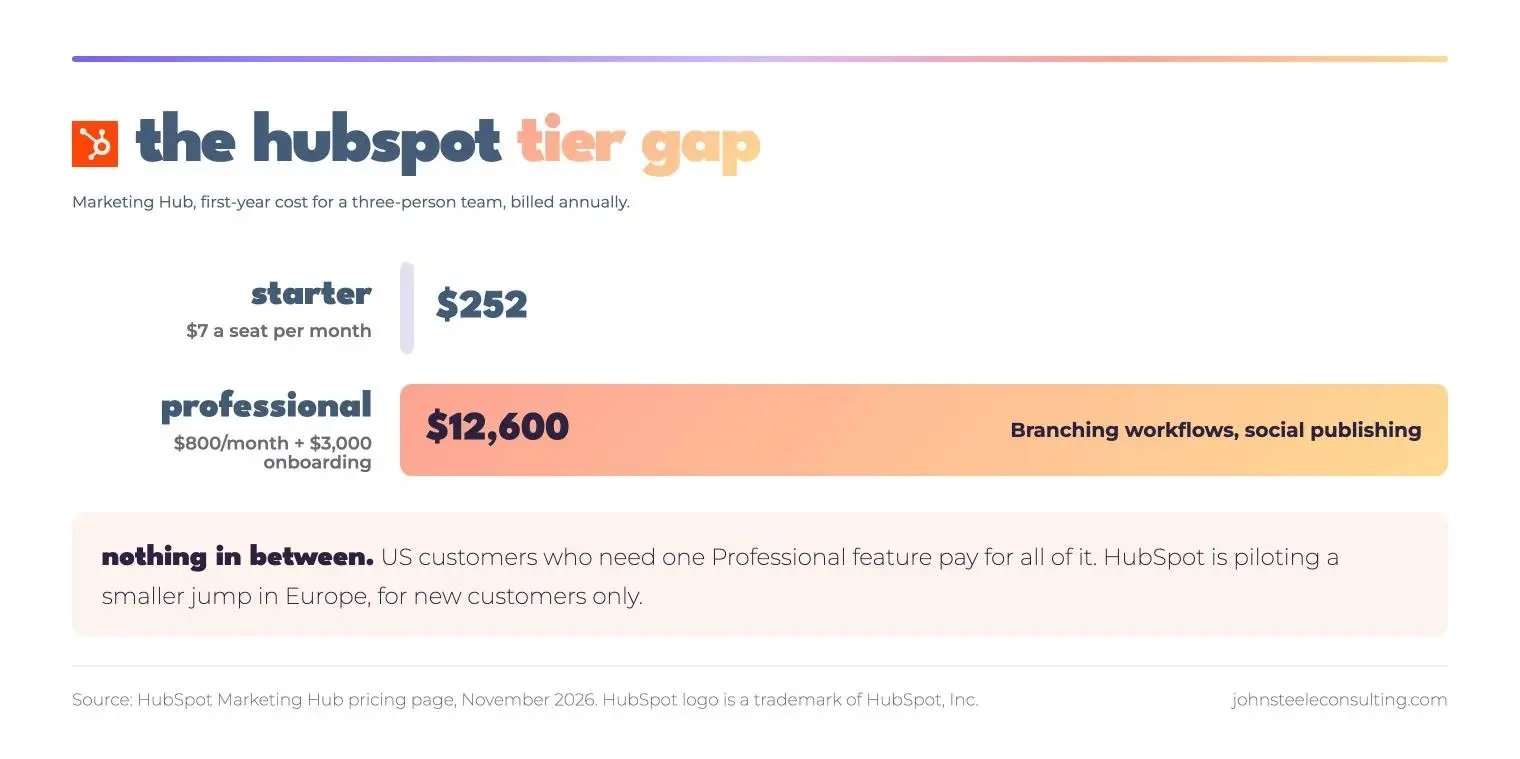
HubSpot has always been expensive. What's changed is the gap between its tiers. On HubSpot's pricing page, Marketing Hub Starter is $7 a seat per month billed annually. Professional is $800 a month for three seats, plus a required $3,000 onboarding fee. There's nothing in between, so some pretty basic functionality, like branching workflows and social publishing, sits behind a jump of more than $12,000 in year one for a three-person team.
 Click to enlarge
Sales used to negotiate and try to keep you on. As prices have gone up, the company has failed to provide any options in between Starter and Pro.
Meanwhile, HubSpot's growth story is increasingly about larger customers. On the Q3 call, CEO Yamini Rangan pointed to deals over $120,000 growing 19% year over year and win rates "nearly three times higher in deals with five or more buying committee members." HubSpot is testing a fix for the gap: a pilot in Europe shrinks the Starter-to-Pro jump for new customers. It doesn't apply to existing customers, and there's no US timeline.
How to read this list
Every CRM and marketing automation platform has a point of view: a way of organizing contacts, deals and activity that makes the whole different from the sum of its parts. So instead of a feature checklist, each profile below answers three questions:
- Point of view: what makes it different from HubSpot and Salesforce
- Built for: who it thinks it serves, judging by those differences
- Why people pay: what it has that you can't easily get elsewhere or build yourself
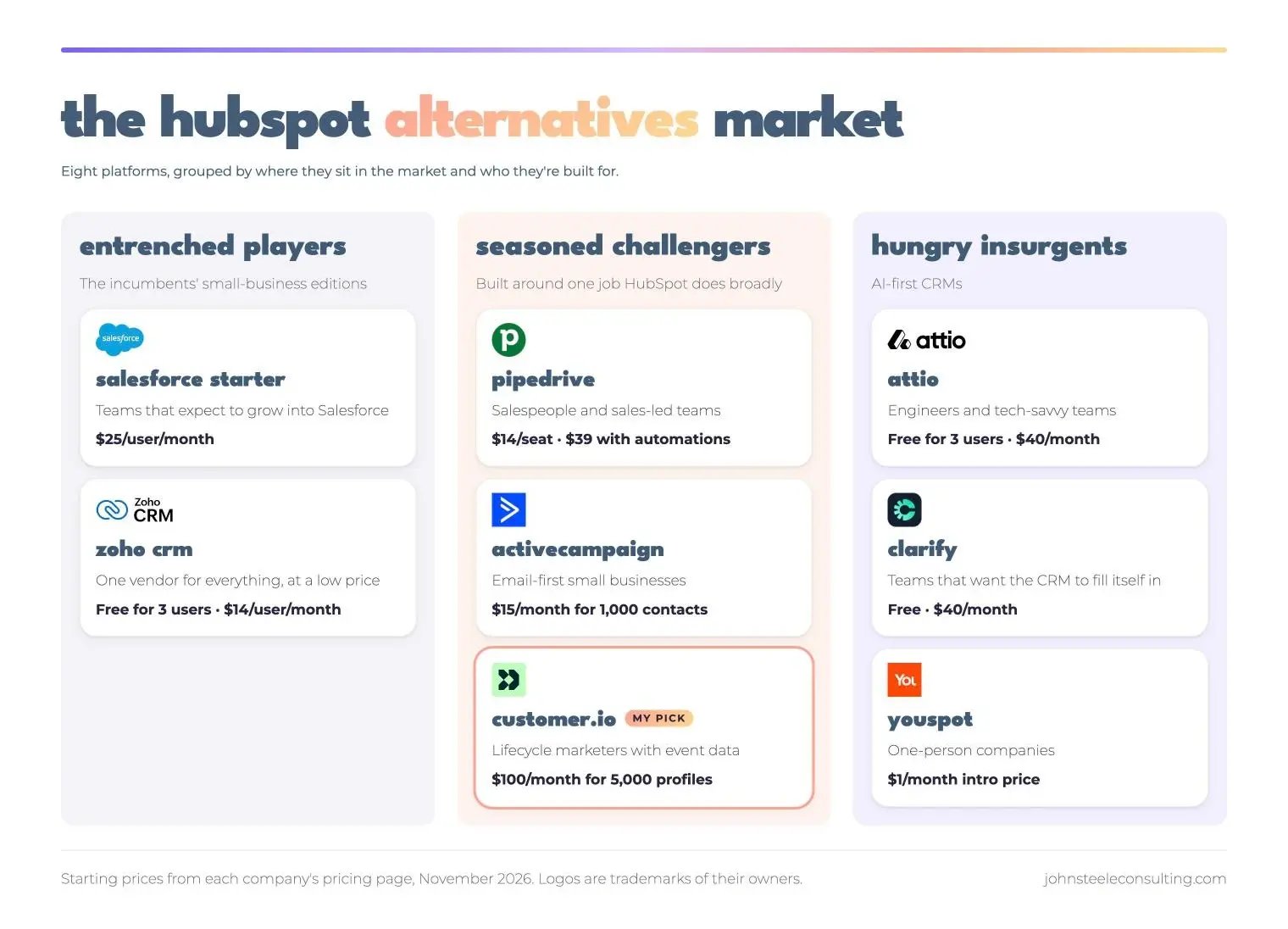
The market splits into entrenched, old-school players, seasoned challengers and hungry insurgents. Prices are starting prices from each company's pricing page as of November 2026.
 Click to enlarge
| Platform | Built for | Starts at |
|---|---|---|
| Salesforce Starter Suite | Teams that expect to grow into Salesforce | $25/user/month |
| Zoho CRM | Price-conscious teams that want one vendor for everything | Free for 3 users; $14/user/month |
| Pipedrive | Salespeople and sales-led teams | $14/seat/month; $39 with automations |
| ActiveCampaign | Email-first small businesses | $15/month for 1,000 contacts |
| Customer.io | Lifecycle marketers with product or event data | $100/month for 5,000 profiles |
| Attio | Engineers and tech-savvy revenue teams | Free for 3 users; $40/month |
| Clarify | Small teams that want the CRM to fill itself in | Free; $40/month |
| YouSpot | One-person companies | $1/month intro price |
The entrenched players
Salesforce Starter Suite
Point of view: Salesforce's data model and ecosystem, packaged for small teams. Starter Suite includes CRM, lead routing, email nurture campaigns and lead scoring.
Built for: teams that expect to outgrow a small CRM and want to stay on one platform when they do.
Why people pay: the AppExchange and the pool of Salesforce admins and consultants. Nothing else has an ecosystem that size.
Watch for: the jump to Pro Suite is $100 per user per month, annual contract required. That's the same tier gap you're leaving HubSpot over.
Zoho CRM
Point of view: one vendor for everything. Zoho CRM connects to Zoho's own email marketing, help desk, finance and analytics apps, and Zoho One bundles 50+ of them.
Built for: price-conscious small businesses that want a full suite without paying suite prices.
Why people pay: breadth for the money. The free edition covers three users, and Standard runs about $14 per user per month billed annually.
The seasoned challengers
Pipedrive
Point of view: the pipeline comes first. Pipedrive calls itself "the easy and effective CRM for closing deals," and everything is organized around moving deals through stages.
Built for: salespeople and sales-led marketing departments.
Why people pay: a CRM sales reps will actually keep updated. Pipedrive says 100,000+ companies use it.
Price: Lite is $14 a seat per month billed annually. Automations and nurture sequences start on Growth, at $39.
Why I passed: I didn't like the workflow builder, and its differentiator works against how I sell. Every interaction is a deal, so it basically opens a deal flow for every person you know. That doesn't make sense for the low volume of sales I do.
ActiveCampaign
Point of view: email marketing and automation first, with a CRM added on.
Built for: small businesses whose marketing runs mostly through email.
Why people pay: a visual automation builder at a small-business price. Starter runs about $15 a month for 1,000 contacts billed annually. Deal pipelines are a paid add-on on Plus and above.
Why I passed: it would have been a good option. But once I decided to keep HubSpot as my CRM and saw how cheaply I could store all my contacts and still get most of the marketing automation features I use, ActiveCampaign's price point, which approaches HubSpot's, didn't make sense.
Customer.io (my choice for email)
Point of view: messages driven by what customers do. Customer.io takes in events and data from your product or site and triggers email, SMS and push from them.
Built for: lifecycle and growth marketers with real behavioral data to work with.
Why people pay: the data layer. Segments and journeys built on any event you send, at a price set by profiles rather than seats.
Price: Essentials starts at $100 a month for 5,000 profiles.
Why I chose it: my email is moving toward behavior-triggered sequences, which is the job Customer.io is built for. Full disclosure: I'm on its startup program, which is free for my first year.
Documint made the same move. Founder Josh Mamroud explains why his team left HubSpot for PostHog and Customer.io on the first episode of the Funnel Vision podcast.

The hungry insurgents
Attio
Point of view: remove the guardrails. Attio lets you define your own objects and data model, and positions itself as a CRM built for AI agents to work in.
Built for: engineers and tech-savvy marketers who want to shape the CRM around their data.
Why people pay: flexibility on core things like objects that HubSpot keeps behind higher tiers. Attio says 30,000+ customers use it.
Price: Free for up to three users. Plus starts at $40 a month billed annually. Email sequences start on Pro, at $100.
Why I passed: it's basically just a CRM. I'm keeping HubSpot as my CMS, which has the capabilities I need, and Attio doesn't have a ton of native integrations. It also isn't really a marketing automation tool, so it didn't feel feature-rich enough to justify the cost. Jack of all trades, master of none.
Clarify
Point of view: a CRM that fills itself in. Clarify builds records from email, calendar and meetings, and charges for the AI's work in credits instead of per seat.
Built for: founders and small revenue teams who won't do manual data entry.
Why people pay: meeting intelligence and enrichment without a seat price. The free plan includes a notetaker and 1,000 credits a month. Starter is $40 a month billed annually for teams of up to three.
Why I passed: the AI felt too green. I didn't find its passive surfacing of new opportunities useful. I tend to act proactively and build my own segments, automations and connections, and letting AI control how connections are formed felt too loosely defined.
YouSpot
Point of view: an AI app with a CRM inside. YouSpot is a HubSpot Next project from co-founder Dharmesh Shah that assembles customer context from email, meetings and relationship history.
Built for: one-person companies. HubSpot has pointed go-to-market teams back to its regular CRM.
Price: $1 a month for the first 1,000 paid seats.
The subtext, as I read it: if you're a solo operator, HubSpot itself may be overkill.
What about building your own?
Plenty of people have publicly argued that AI makes the off-the-shelf CRM optional, and some have shipped their own. In Growth Unhinged, Alex Shartsis described a personal AI CRM he set up in Claude Desktop in about 20 minutes, for $20 a month. He also listed its limits: connections that drop, datasets too large for the AI to hold at once, and results that need checking because the AI sometimes fills gaps with invented data.
We recommend getting the most you can out of your existing tools rather than spending a lot of time reinventing the wheel. Chances are, an available workaround, or even an AI-built plugin, could solve your problem better than a whole new, completely untested system you elevate to the center of your business.
What I chose
- CRM: staying on HubSpot, on a much smaller plan. My contact history lives there, and nothing about the job requires Professional.
- CMS: staying on HubSpot. I've built 15–20 custom modules for my site and edit them from the command line with Claude Code.
- Email and automation: Customer.io.
- Social: a standalone scheduler.
My target for the whole stack is $2,500 to $3,000 a year, against the roughly $7,000 I pay now.
Picking a platform is the easy part. For how to evaluate one properly, plan the move and test it before you lose access, see How to Migrate Off HubSpot.
HubSpot alternatives FAQ
What's the best HubSpot alternative for a small business?
It depends on who you are. Sales-led teams tend to fit Pipedrive. Email-first businesses fit ActiveCampaign. Teams with product or event data fit Customer.io. Teams that want to define their own data model fit Attio.
Is there a cheaper alternative to HubSpot?
Yes. Zoho CRM and Attio both have free plans for up to three users, and Pipedrive starts at $14 a seat per month. You can also keep HubSpot's CRM on a lower tier and move only the expensive jobs, like email automation, somewhere else.
Can you keep HubSpot's CRM and use a different email platform?
Yes. That's what I did: HubSpot stays as my CRM and CMS on a much smaller plan, and email automation moved to Customer.io.
Does HubSpot have a plan between Starter and Professional?
Not in the US. HubSpot is piloting pricing in Europe that shrinks the Starter-to-Pro jump for new customers, but it doesn't apply to existing customers.
Budget is a bigger question
Budgeting for a move is more complicated than comparing license fees. To know what your marketing stack should cost, you need to know what each of your marketing channels returns.
That's what a HubSpot audit from JSC is for. It looks at what your portal is doing, what it's costing you, and what's worth keeping, whether you end up leaving HubSpot or staying on a smaller plan.
If you want more of these teardowns, including how this one turns out, subscribe to Funnel Vision. Full disclosure: it's my newsletter.